
Preparation involved splitting the original movie clip into 12 separate reference shots, producing storyboard sketches, and creating a detailed shoot log covering pre-production, production, and post-production stages. While the storyboard was less useful, the reference clips and shoot log proved essential for efficient shooting and organisation.
Unreal Engine
This project was primarily made in Unreal Engine.
-
Data Cleanup in Shogun Post
Captured data was imported into Shogun Post for systematic cleanup of rigid bodies, focusing on jitter and marker swaps, especially in the hands. Solving issues were addressed by re-adjusting markers and re-solving skeletons. While major problems were fixed, more time could have been spent refining hand data for a stronger base going into Motion Builder.
-
Retargeting and Motion Editing
Using Motion Builder, mocap skeletons were retargeted to MetaHuman characters. Problems such as bent spines and gaps during contact animations were solved by manual corrections and animation layers with blended keyframes. However, mistakes in workflow, such as not using namespaces, led to extra work during export to Unreal Engine.
-
Final Scene Assembly
The cleaned and retargeted data was imported into Unreal Engine’s sequencer, where camera movements, lighting, and a background environment were added. Time constraints prevented the integration of face capture data, though the workflow for this was understood. Despite this, the scene successfully recreated the dramatic sequence and demonstrated a complete end-to-end mocap pipeline.
-
Code Quality & Reusability
The code was developed with professional standards in mind, using Unreal’s recommended naming prefixes, consistent commenting, and modular blueprints. This made the game easier to understand, maintain, and expand. The systems could easily be reused for new levels with only small adjustments. I identified a future improvement opportunity: adding more descriptive comments to explain how systems function, rather than only what they do.
-
Timer System
Originally, Level 2 included a monster that chased the player, but I replaced this mechanic with a timer. This kept the level equally challenging but avoided the complexity and performance cost of pathfinding code. The timer was first implemented in a separate blueprint, but casting issues prevented it from displaying correctly on the HUD. To fix this, I moved the timer code into the HUD blueprint. I later used the “get current level name” node to ensure the timer only appeared in Level 2, solving an activation bug.
-
Efficient Level & Key Design
Both levels used the same number of keys, which allowed me to reuse the same door and key code for both. In Level 2, keys spawn randomly, introducing replayability without adding new systems. Additionally, splitting the two levels into separate worlds reduced data load, as the computer didn’t need to hold all assets at once.
-
Game Theme
As a team, we wanted the game to have an ancient greek theme with a comedy vibe. The game includes two gods as playable characters (Zeus and Poseidon) along with 2 funny characters that the player can use (Jesus with a gun and Bob, who is just a regular man.)
-
Development
During the creation of this project I learned how to make a game menu – a valuable skill which I have used in many games since.
Menu
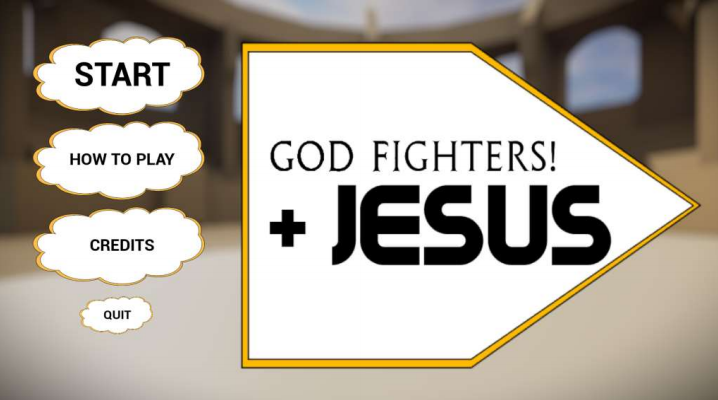
In this project I created the basic menu and also created the art for the menu, such as the buttons, which were clouds, with text on them:

I also learnt how to add a rollover image so that the button would change when you hovered over it. As a result the final menu was created:
Audio Design
There were two members of the group assigned to the audio design of the game. I was given the task of sound effects, and developing the noises in the game. This task involved looking at the different actions we had in the game and looking online for appropriate sounds that were non-copyright and free to use.
